 |
|
|
|


 |
|
|
The position of treelines is not driven by
|
 1 1
 2 2
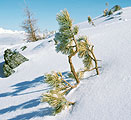 3 3
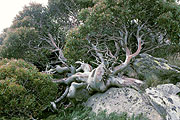 4 4
 5 5
 6 6
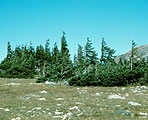 7 7
 8 8
|
|
| Stress and pathogens in the treeline ecotone (1-3) | ||
| 1. | Late frost damage in spring (note: the current season flush has been killed and turned brown). | |
| 2. | Fungal infections. Swiss treeline at 2250 m. | |
| 3. | Winter desiccation. Austrian treeline at 2100 m. | |
| "Krummholz" above treelines (4-8) | ||
| 4. | Eucalyptus pauciflora, 2050 m, Mt. Perisher, Snowy Mts., Australia. | |
| 5. | Tsuga, Abies, Larix, 2200 m, Mt. Fuji, Japan. | |
| 6. | Pinus flexilis, Abies lasciocarpa, Picea engelmannii, 3400 m, Niwot Ridge, Colorado, Rocky Mts. Front Range. | |
| 7. | Tree islands of Picea engelmannii, 3350 m, Medicin Bow Mts., Rocky Mts., Wyoming. | |
| 8. | Pinus mugo, 1900 m, Lechtal Alps, Austria. | |
|
In summary, not all regions of the world have treeline species which can survive at the climatic treeline. In regions which have such taxa, the position of the treeline is determined by a globally common factor (temperature) plus regionally variable (modulating) factors (other climate components, soil or biotic factors). The climatic treeline is found at a mean growing season temperature of c. 5 °C in the tropics and c. 7 °C outside the tropics. |
 back
to top back
to top |
29 August 2011 |
||
| |
||