Findings
With our map we were able to conclude that the most shaded path through Zurich greatly depends on various factors like the date and time, the start and end locations, as well as the layout and geometry of the urban cityscape. We have condensed our most important findings into five main points below.
1) Uneven Shade Distribution
The analysis revealed that shade is distributed unevenly throughout the urban environment. Factors such as building height, street orientation, and the angle of the sun strongly influence where and when shaded areas occur. Dense urban canyons and tree-lined streets generally provide more consistent shade, while wide open roads remain highly exposed to direct sunlight.
2) Cool Detours prevent heat stress
One of the key findings is that even small detours can potentially improve thermal comfort. Routes that were only slightly longer than the shortest path often provided substantially higher levels of shade exposure. This suggests that minor adjustments in route choice can reduce pedestrian heat exposure during hot summer days.
3) Optimal Routes change with time of day
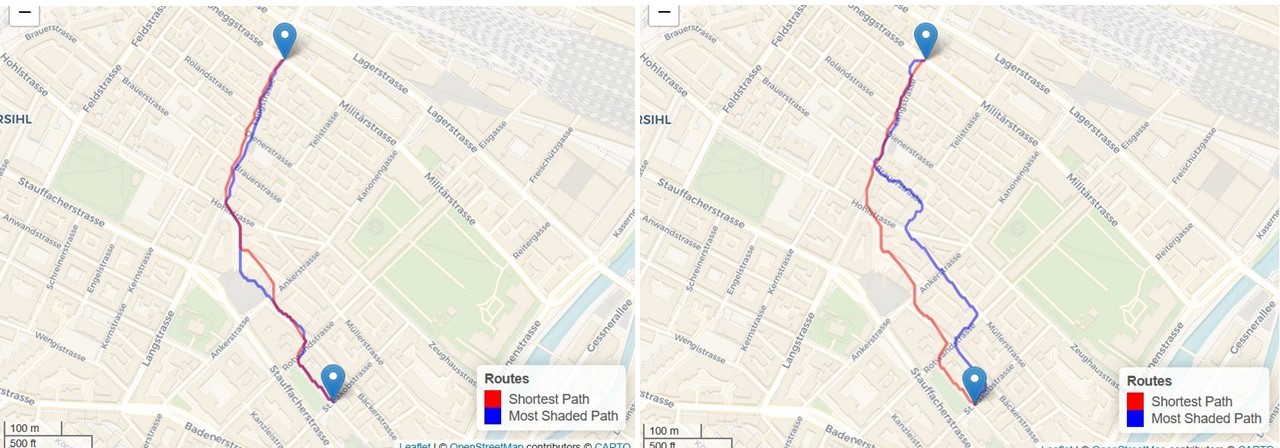
Looking at the same route at different times shows that optimal shaded routes can change considerably. By comparing routes at three different times of the day and throughout the summer months, it became evident that shifting sun angles continuously alter the spatial distribution of shade. As a result, routes that are comfortable in the morning may become more exposed during the later hours of the day.
The image below demonstrates this, as it shows how the most shaded path between the same two points changes in July between 09:00 (left) and 15:00 (right) o'clock.
4) Shade Corridors
The interactive map highlights the existence of “shade corridors” within the city. Certain streets consistently offer higher levels of shade due to narrow street geometry, or height of surrounding buildings. These corridors create more thermally comfortable pathways for pedestrians and often feature in the most shaded paths.
5) Shaded paths are not an easy fix for heat issues
While shade is an important factor for heat stress adaptation, it is only one component of the urban microclimate. Wind conditions, humidity, vegetation, and surface materials also strongly influence the urban heat island and pedestrian comfort. Therefore, future routing approaches could benefit from integrating additional environmental parameters beyond shade alone.