 |
|
|
|


 |
|
|
The short growing season and cold conditions in arctic-alpine environments have selected for slow growing perennials with development processes extended over more than one season. In the most extreme habitats cushion plants dominate, in less extreme habitats clonal plants with lateral spread are common. Despite the costs of maintaining connections between ramets (respiratory costs, higher risk of genet mortality), many clonal plants maintain an interconnected shoot sytem of considerable size. When connections between parent and daughter ramets persist for some time, the shoot system may be physiologically integrated to a variable degree, i.e. photosynthates and nutrients may be shared among ramets. Strong integration over large distances is particularly frequent in clonal plants from cold environment. |
|
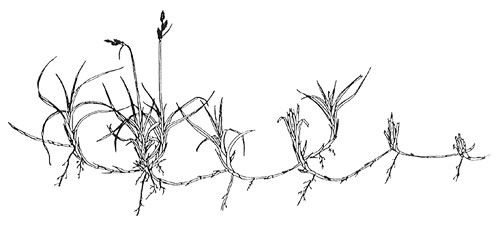
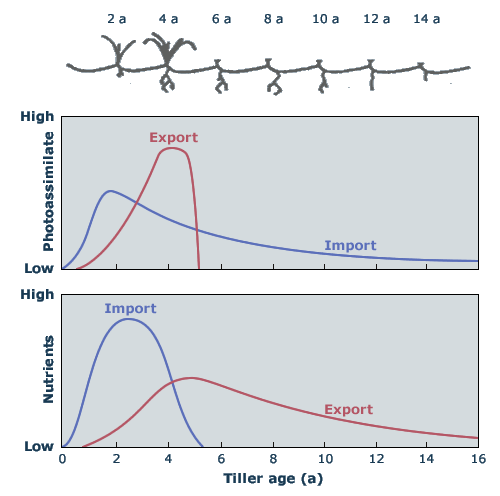
1 - In graminoids clonal growth and physiological integration is a phlogenetically ancient property. The role of such integration is particularly well studied in the arctic-alpine sedge Carex bigelowii. This plant consists of numerous interconnected shoots, forming a branched rhizome system, where up to 27 tiller generation may be connected. Only young tillers have photosynthetic active above ground parts but may translocate carbon basypetally over more than one meter in segments as old as 20 years in only one minute. Roots up to 14 years old took up nitrogen that was translocated acropetally into young photosynthesizing tillers. |
|
2 - Division of labour in clonal plants. Changes in the amount of export and import of photoassimilate (above) and nutrients (below) in horizontally spreading actic-alpine graminoids, demonstrating division of labour in time and space (after Jonsdottir et al. 1996). |
|
Adaptive advantages of interconnected ramets to cold environments
|
 back
to top back
to top |
29 August 2011 |
||
| |
||