Findings
Results
The map analyzes labor market participation and educational completion rates for men and women in different regions of the world from 2000 to 2023.
The data are examined in four main categories: labor force participation rate, primary education completion rate, secondary education completion rate,
and tertiary education completion rate.
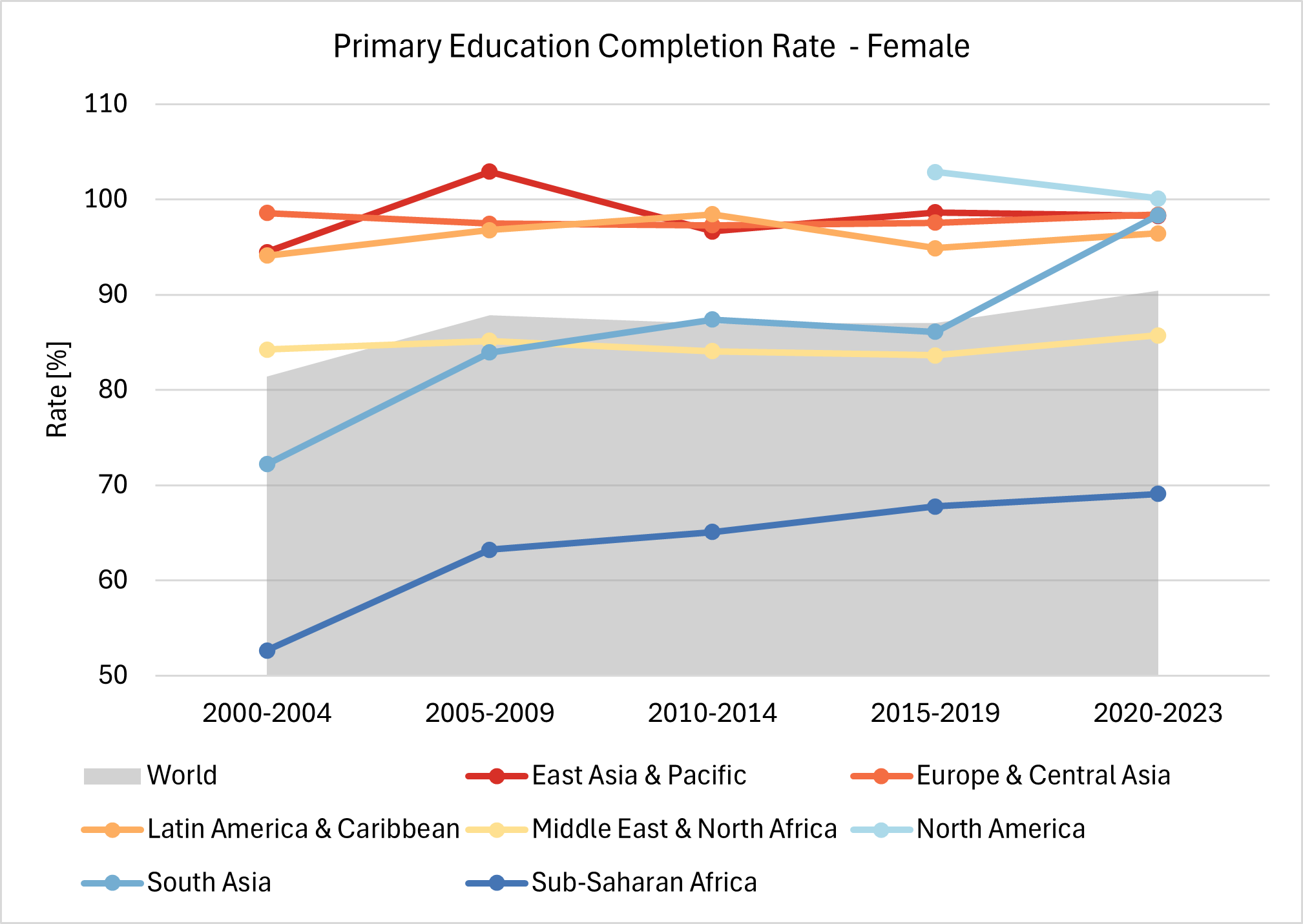
Figure 1 shows the primary completion rate for women. The primary completion rate for women shows a positive trend worldwide. In East Asia and the Pacific,
the rate increased from 94 percent in 2000-2004 to 98 percent in 2020-2023. In South Asia, the rate increased substantially from 72% to 98%. In sub-Saharan Africa,
the rate increased from 52% to 69%.
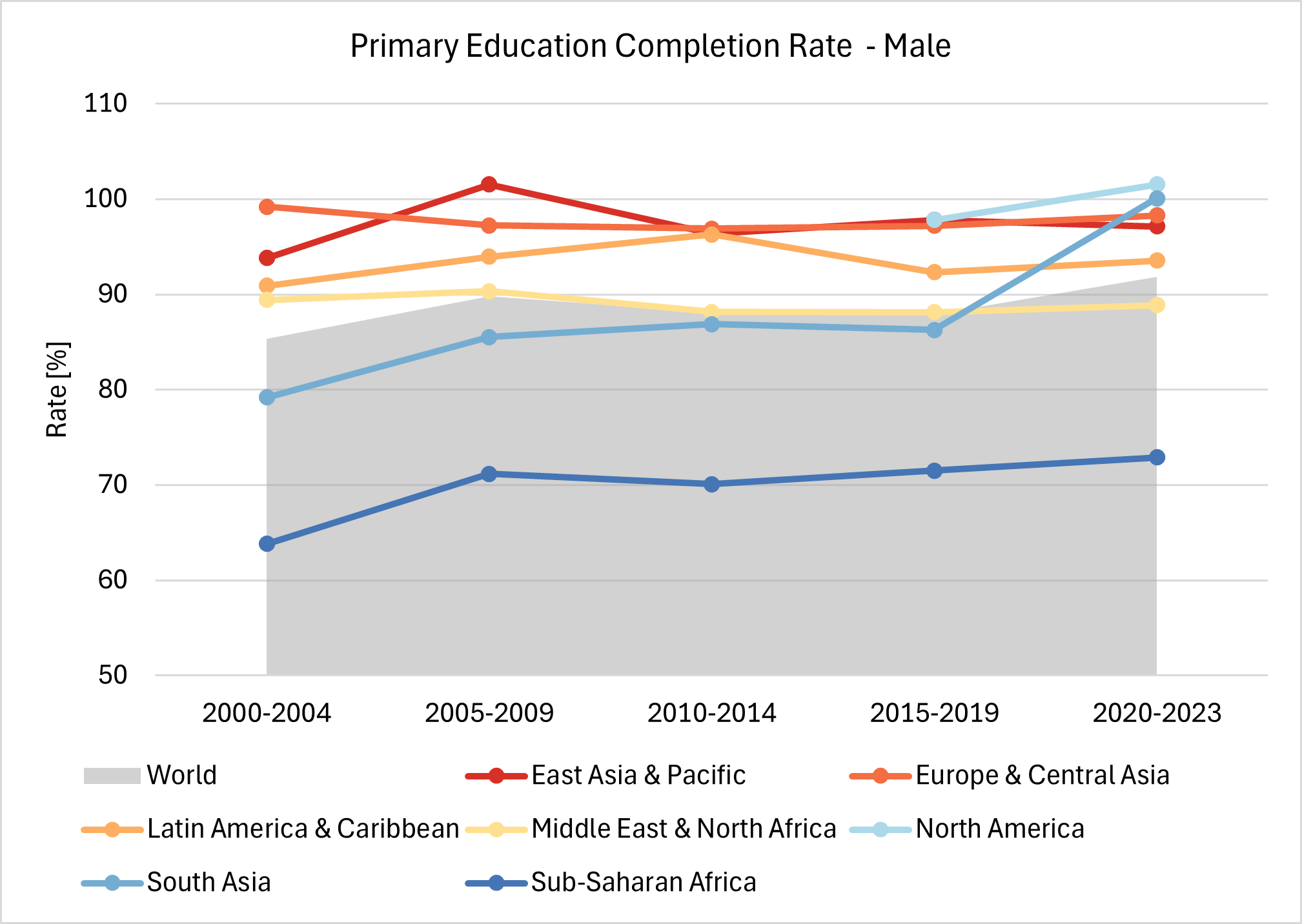
The primary completion rate for males, shown in Figure 2, also shows improvement. In South Asia, the rate rose from 79% to 100%, a significant increase. In Sub-Saharan Africa,
the rate increased from 63% to 72%. In Latin America and the Caribbean, the rate increased from 90% to 93%.
 |
 |
|---|---|
| Figure 1: Primary Education Completion Rate - Female | Figure 2: Primary Education Completion Rate - Male |
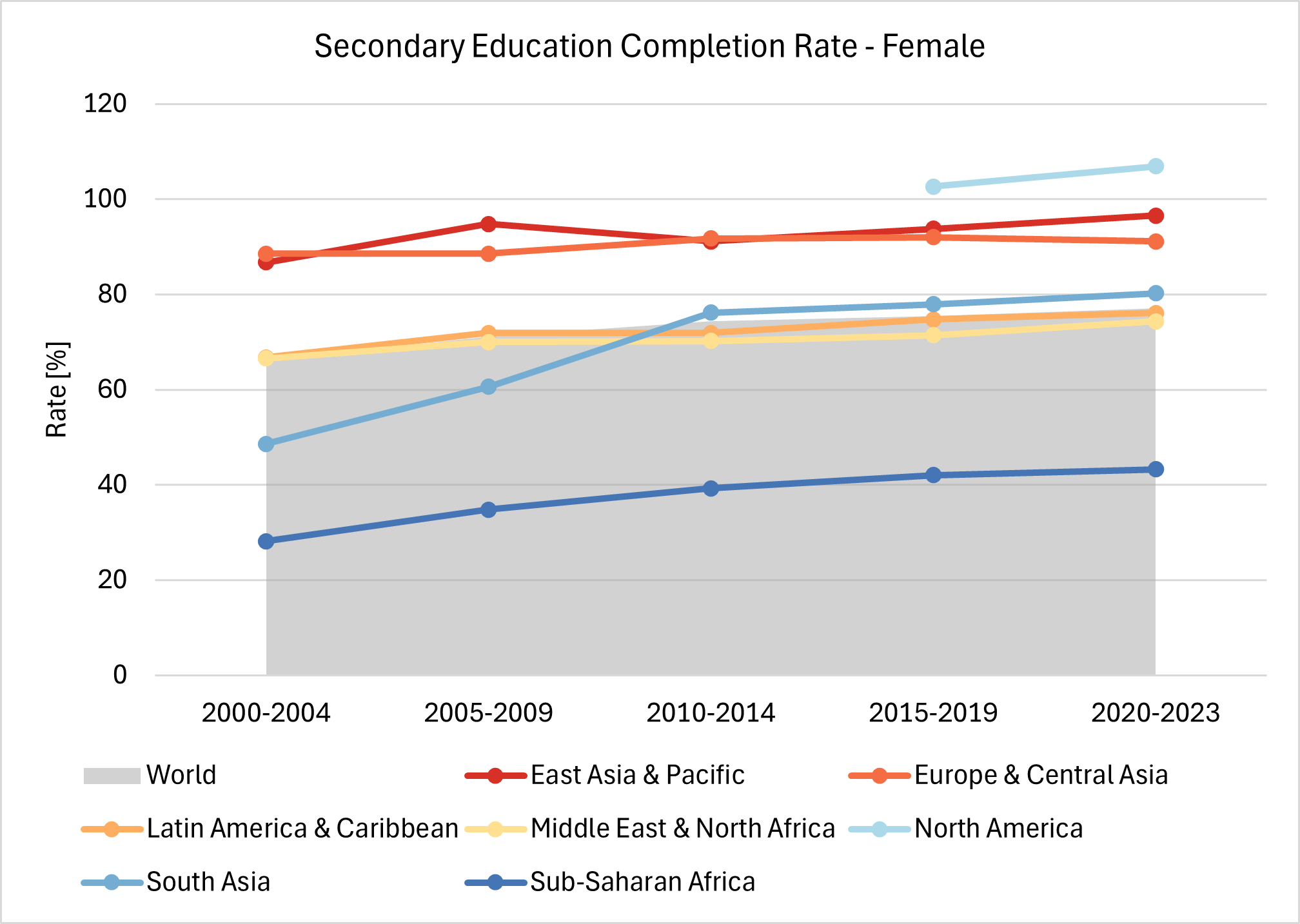
The secondary completion rate for women is shown in Figure 3 and shows positive trends worldwide. In East Asia and the Pacific, the rate increased from 86% in 2000-2004 to 96%
in 2020-2023. In South Asia, the rate increased from 48 percent to 80 percent. In Latin America and the Caribbean, the rate increased from 66% to 76%.
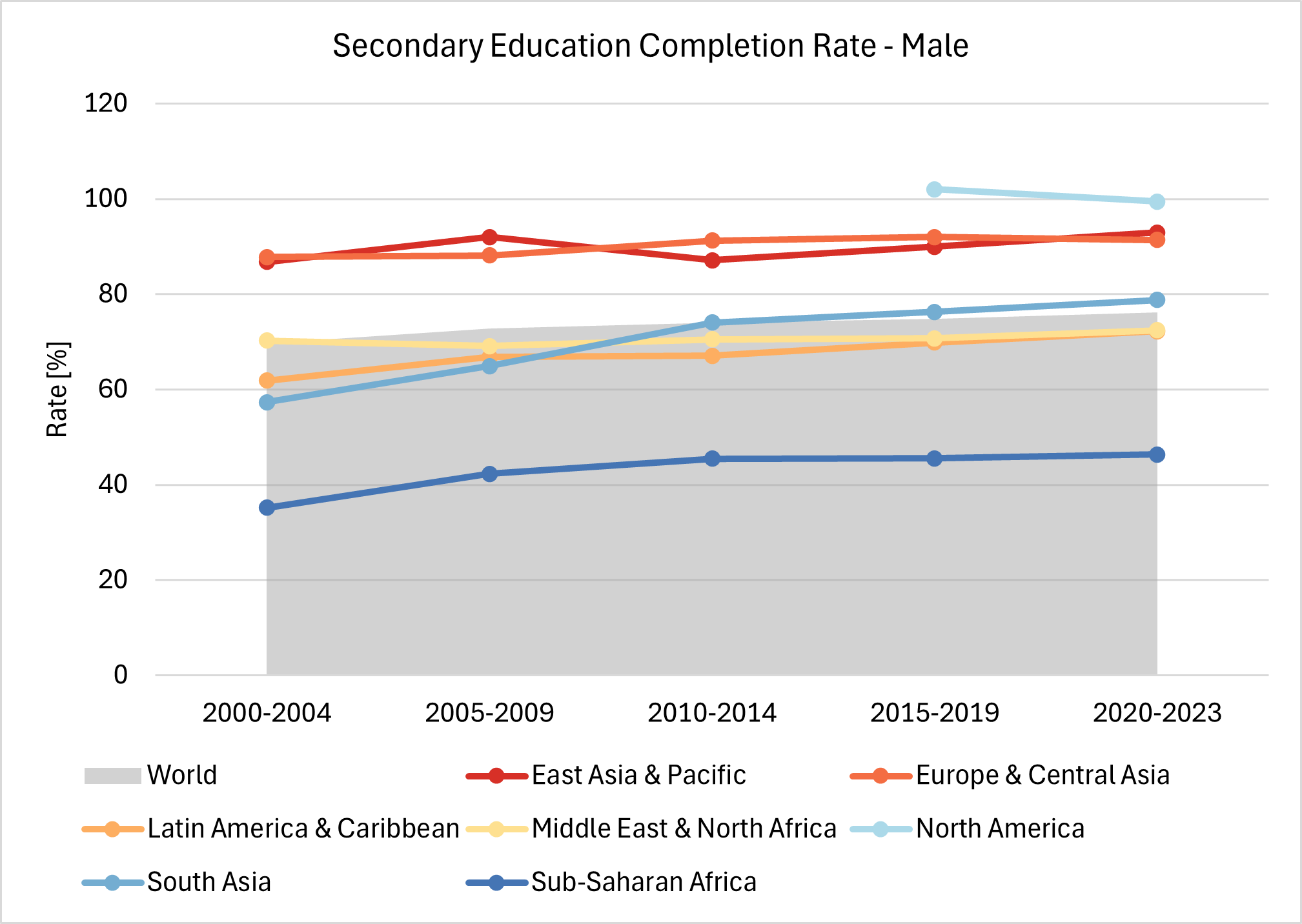
The secondary completion rate for males is shown in Figure 4 and also shows positive trends. In East Asia and the Pacific, the rate increased from 86.78% to 92.97%.
In South Asia, the rate increased from 57 per cent to 78 per cent. In Latin America and the Caribbean, the rate increased from 61% to 72%.
 |
 |
|---|---|
| Figure 3: Secondary Education Completion Rate - Female | Figure 4: Secondary Education Completion Rate - Male |
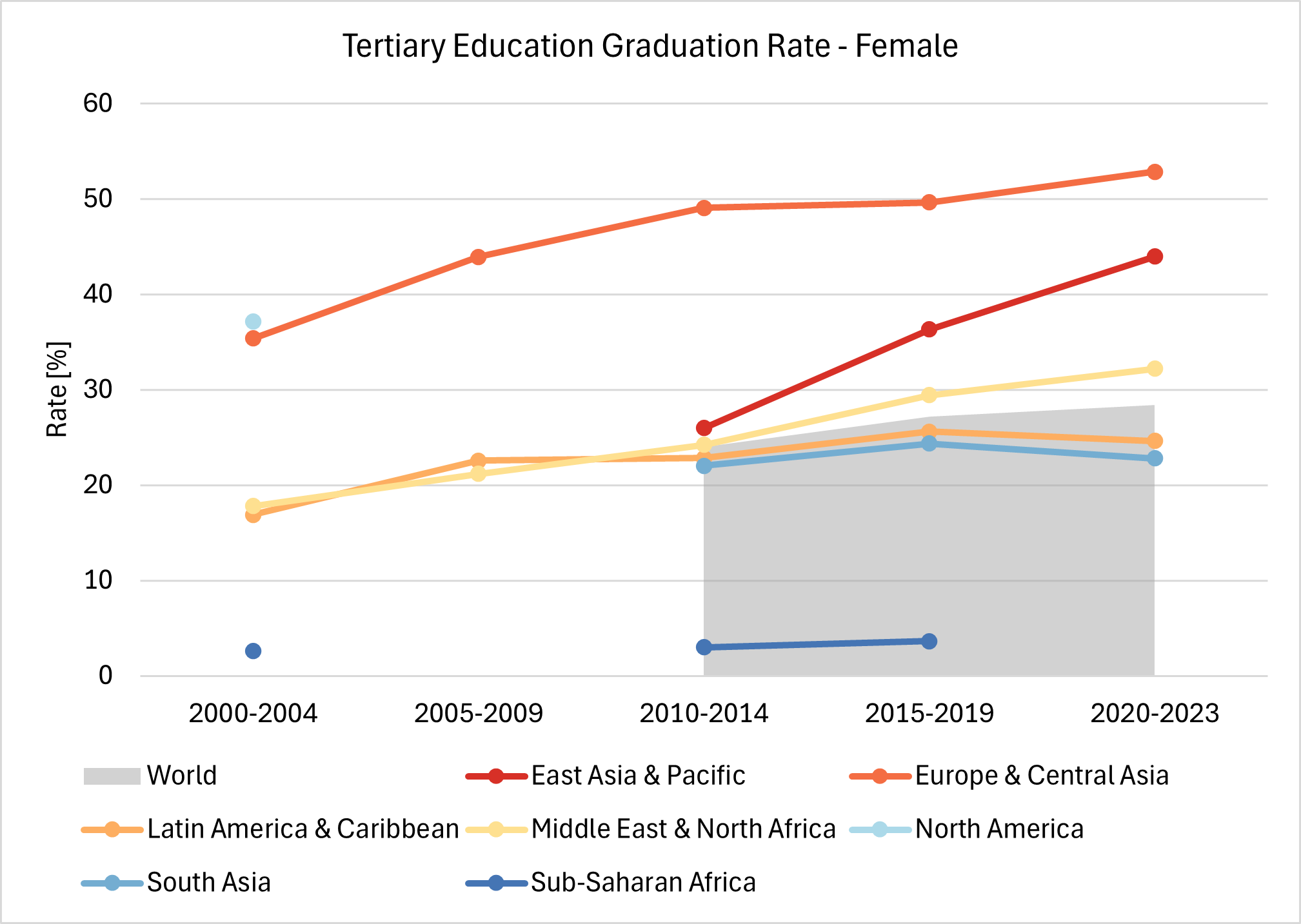
The tertiary completion rate for women is shown in Figure 5 and shows a significant increase globally. In East Asia and the Pacific, the rate increased to 43% in 2020-2023.
In Europe and Central Asia, the rate increased from 35 percent in 2000-2004 to 52 percent in 2020-2023. In the Middle East and North Africa region, the rate increased from 17%
to 32%.
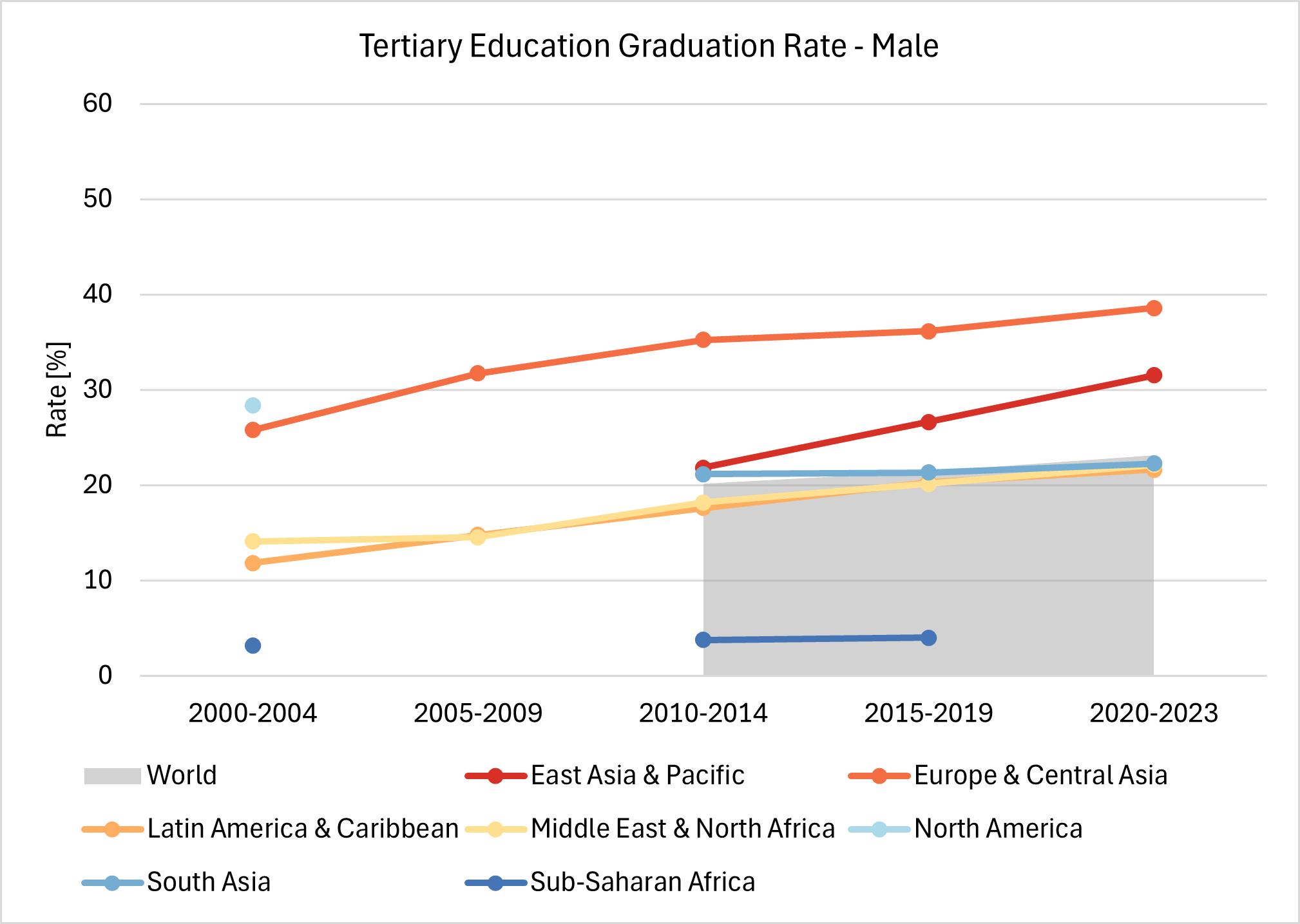
The tertiary completion rate for males is shown in Figure 6 and also shows positive trends. In Europe and Central Asia, the rate increased from 25% to 38%.
In Latin America and the Caribbean, the rate increased from 11% to 21%. In the Middle East and North Africa region, the rate increased from 14% to 22%.
 |
 |
|---|---|
| Figure 5: Tertiary Education Graduation Rate - Female | Figure 6: Tertiary Education Graduation Rate - Male |
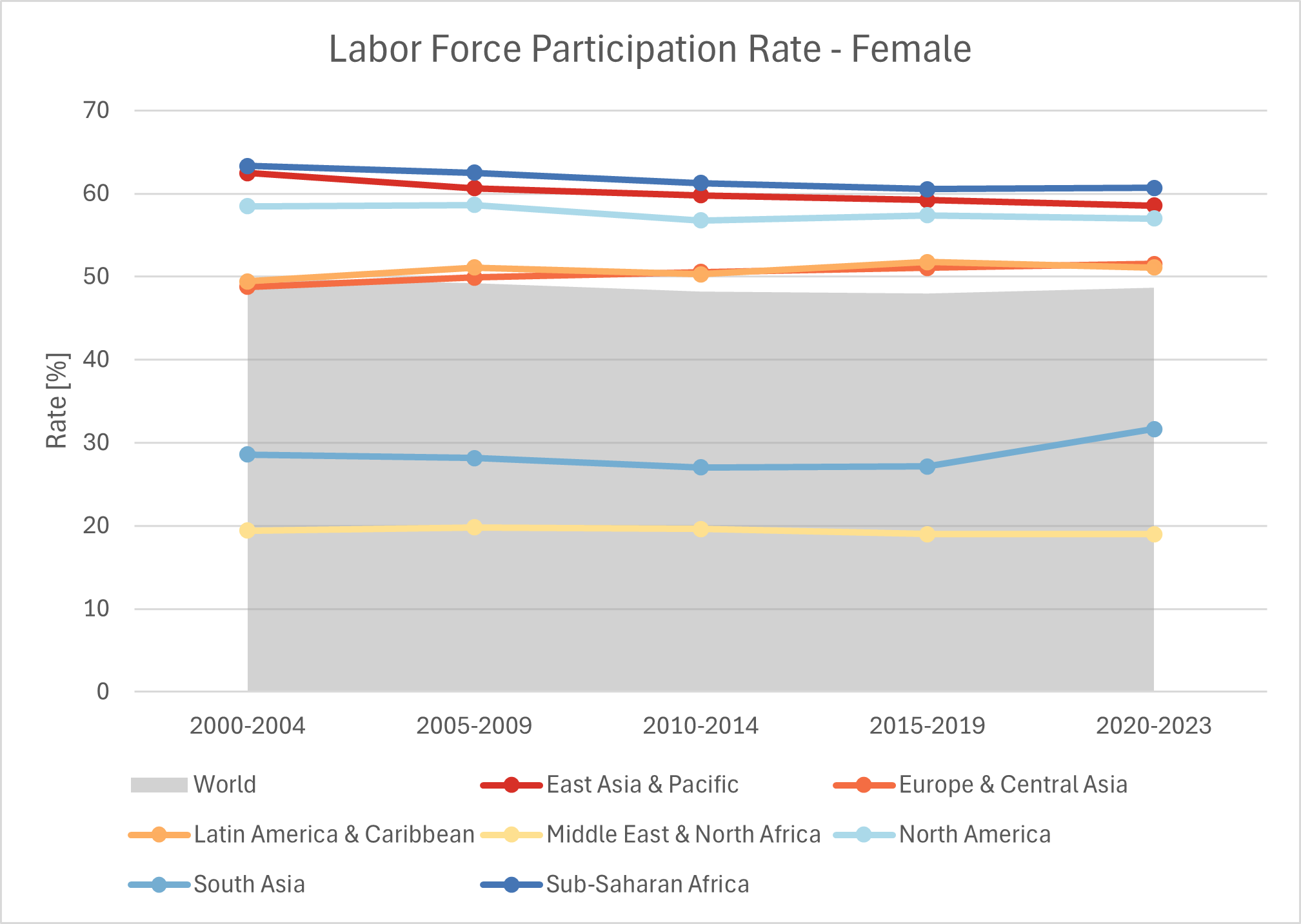
The female labor force participation rate shows a mixed picture, as shown in Figure 7. In East Asia and the Pacific, the rate fell from 62% to 58%.
In Europe and Central Asia, however, it increased from 48% to 51%. In South Asia, the rate rose from 28% to 31%, while in the Middle East and North Africa it
remained almost constant at 19% and 57% respectively.
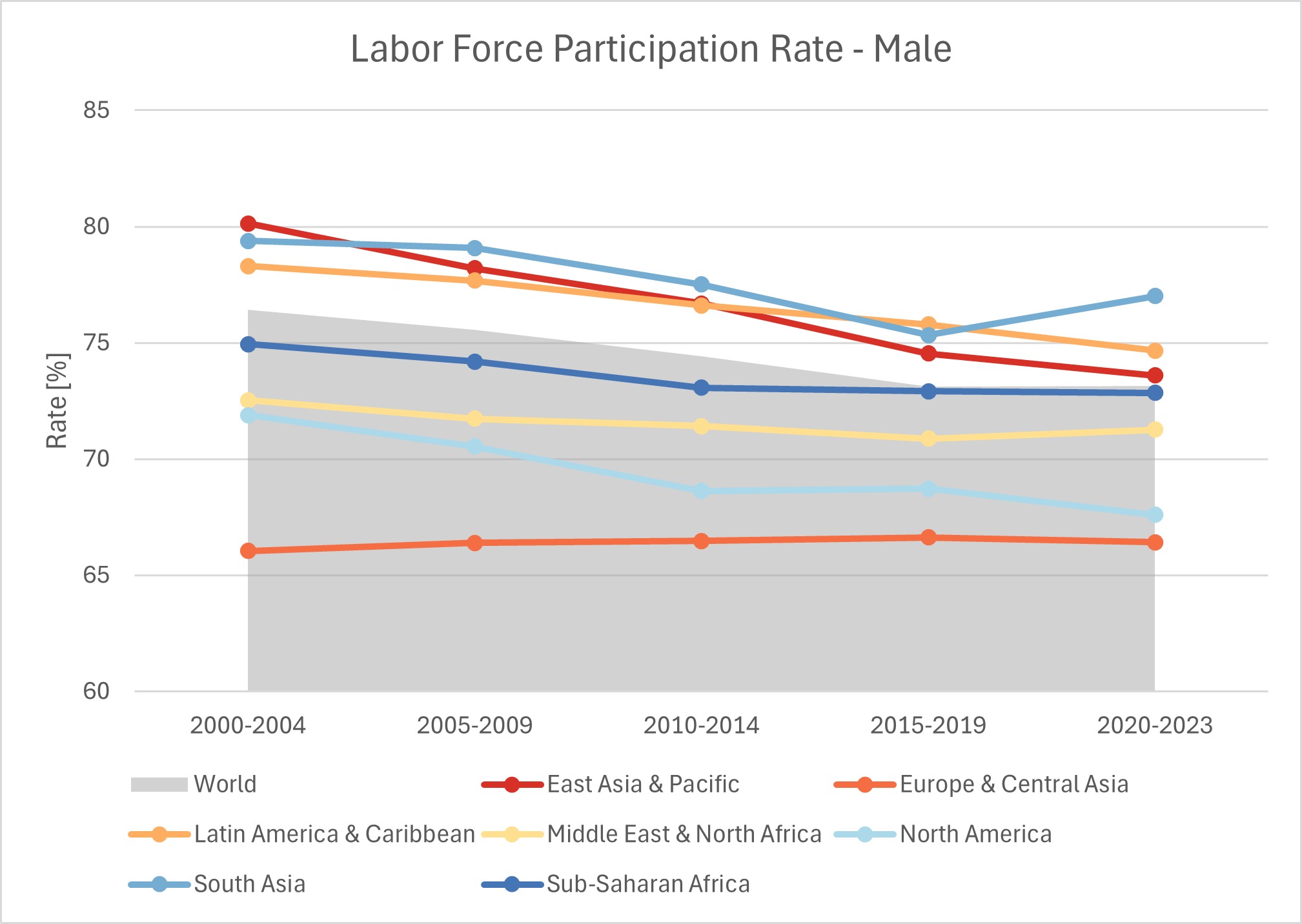
The labor force participation rate for men is shown in Figure 8 and shows a global decline. In East Asia and the Pacific, the rate fell from 80% in 2000-2004 to 73% in
2020-2023. Similarly, in Latin America and the Caribbean, the rate fell from 78% to 74%. In North America, the decline was from 71% to 67%. In contrast, the participation
rate in Europe and Central Asia remained relatively stable at 66%.
 |
 |
|---|---|
| Figure 7: Labor Force Participation Rate - Female | Figure 8: Labor Force Participation Rate - Male |
Discussion
The analysis shows that improvements in women's educational attainment do not always correlate directly with higher labor force participation.
While some regions, such as South Asia and Europe and Central Asia, show a positive correlation between higher educational attainment and labor force participation,
there are regions, such as East Asia and the Pacific and Sub-Saharan Africa, where labor force participation is declining despite better education. Several factors explain these
discrepancies.
In many regions, structural barriers remain that make it difficult for women to enter the labor market despite higher levels of education.
These include gender discrimination, unequal pay and limited opportunities for advancement. Women are often concentrated in sectors with lower wages and less stability,
such as the informal economy or part-time work, which limits their economic participation and career opportunities (7).
In some cultures and societies, there are traditional role models that limit women's participation in the labor market, despite good education. Gender stereotypes and the expectation
that women are primarily responsible for the home and childcare can prevent women from pursuing their career ambitions. These norms often act as invisible barriers, blocking access
to quality jobs and career opportunities despite high levels of education (8).
Economic recessions or slow growth can reduce the demand for labor, affecting women in particular. In times of economic uncertainty, women can be pushed out of the labor market
more quickly, and there is less investment in jobs and training programs that could improve their employment opportunities. As a result, women struggle to find stable and well-paid
jobs despite having good qualifications (8).
The presence or absence of laws and policies that promote gender equality in the workplace plays a crucial role. Countries with strong anti-discrimination laws,
family-friendly working conditions and targeted support for women in the workplace tend to have higher female participation rates. Conversely, a lack of legal frameworks
and political will to enforce gender equality policies can significantly hinder women's integration into the labor market (9).
Family policies such as parental leave, childcare facilities and flexible working hours can improve the reconciliation of work and family life and increase female participation.
Regions that invest in such policies often see higher female participation rates as women are better able to manage the dual burden of work and family (10, 11).
In summary, the data show that improving women's educational attainment is an important, but not sufficient, factor in increasing female participation. More comprehensive
approaches that address structural, cultural and economic barriers are needed to promote women's integration into the labor market. Policies that specifically target the promotion
of gender equality, challenge cultural norms and improve economic conditions are needed to fully exploit the positive effects of higher educational attainment and sustainably increase
female participation. Only a holistic approach that addresses education, labor market policies and social norms can achieve true gender equality in the labor market.
Conclusion
The analysis of women's educational attainment and labor force participation worldwide between 2000 and 2023 shows that women's educational attainment has improved significantly,
particularly in regions such as South Asia and East Asia and the Pacific. However, female labor force participation remains below expectations in many regions, reflecting complex
and often region-specific factors.
While progress has been made in education, this alone is not sufficient to significantly improve women's labor market integration. Structural barriers, cultural norms and economic
conditions play a crucial role. In Europe and Central Asia, there is a positive correlation between education and labor market participation, while in regions such as East Asia and
the Pacific or Sub-Saharan Africa, labor market participation is either stagnant or declining despite higher educational attainment.
Comprehensive measures are needed to improve women's labor market integration worldwide. These include promoting gender-responsive labor market legislation, creating jobs and removing
cultural and social barriers. Only through a holistic approach the positive effects of higher educational attainment can be fully exploited and women's participation in the labor market
be sustainably increased.
Overall, this analysis shows that education is an important key to women's emancipation and economic participation, but it is only one piece of the puzzle. The integration of women
into the labor market requires coordinated efforts at the political, economic and social levels to achieve long-term and sustainable improvements.