Findings
The maps provide a powerful visual representation of emissions and climate change impacts across countries worldwide. A clear spatial pattern emerges: nations in the Global North have contributed significantly more to greenhouse gas emissions than those in the Global South since 1995. This pattern would be even more pronounced if historical emissions since the beginning of industrialization were included. Conversely, the impact index values are lower for the Global North compared to the Global South, as shown in the right map. A more detailed analysis reveals that readiness levels to face climate change are significantly higher in the Global North, owing to their economic, technological, and governmental strengths. In contrast, vulnerability levels are generally lower in the Global North compared to the Global South. The maps therefore show that there is a connection between emissions and the impact of climate change at country and continent level. This correlation was analyzed in more detail using statistical methods to answer the research questions.
Answering of Research Questions
The following conclusions can be drawn for answering the research questions:
1. How do greenhouse gas emissions correlate with impact of climate change across different global regions, particularly between continents?
Greenhouse gas emissions exhibit a significant negative correlation with the impact of climate change across all nations worldwide as is shown in the first graph. Hence, the higher the greenhouse gas emissions, the lower the observed impact of climate change. A mixed model analysis in the second graph reveals that this correlation holds true for every continent but is significantly stronger for Africa, Asia, the Americas, and Oceania. More detailed assessments of this correlation can be explored in the interactive graph in the MAPS section.
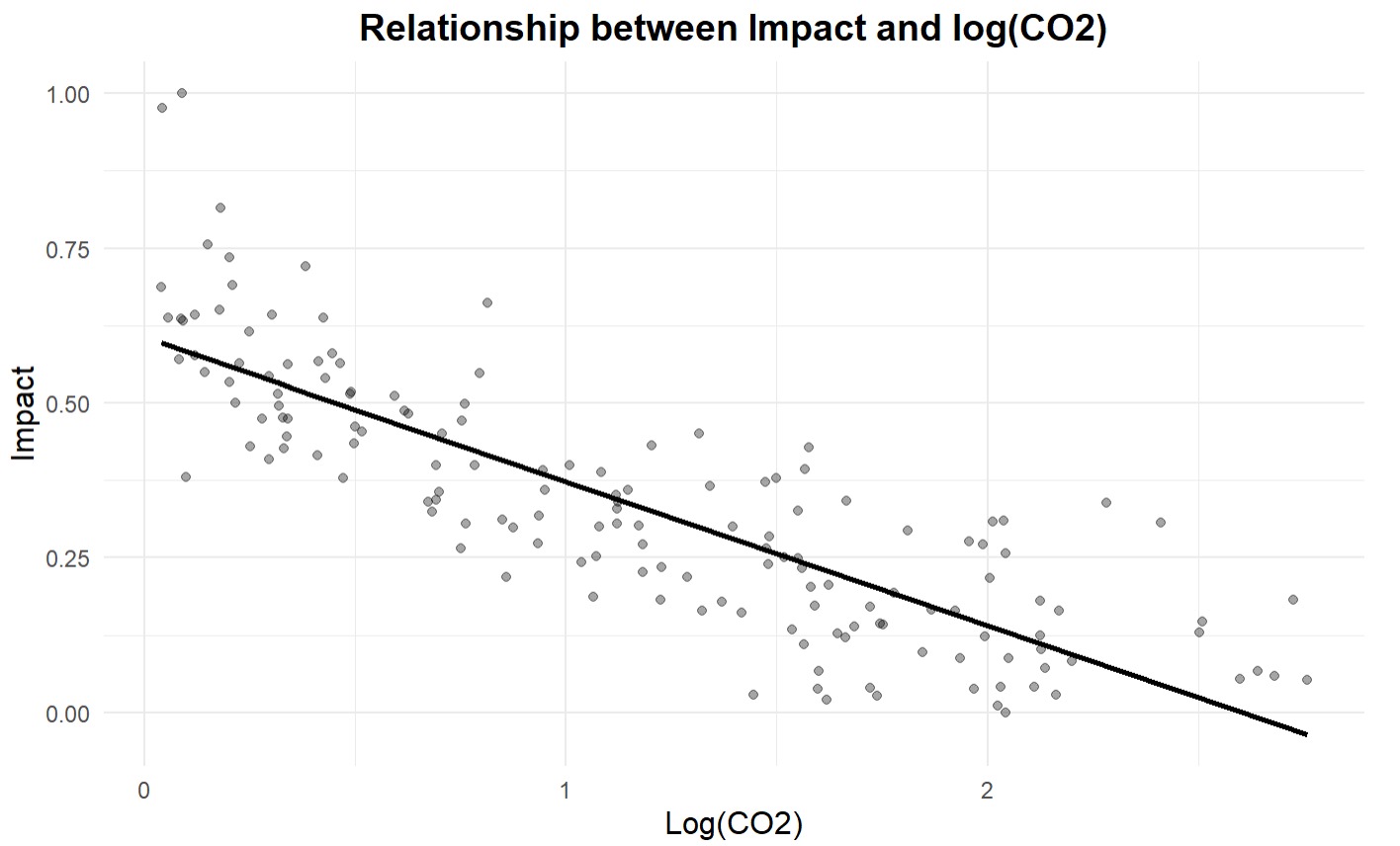
Graph 1: Correlation of impact and CO2
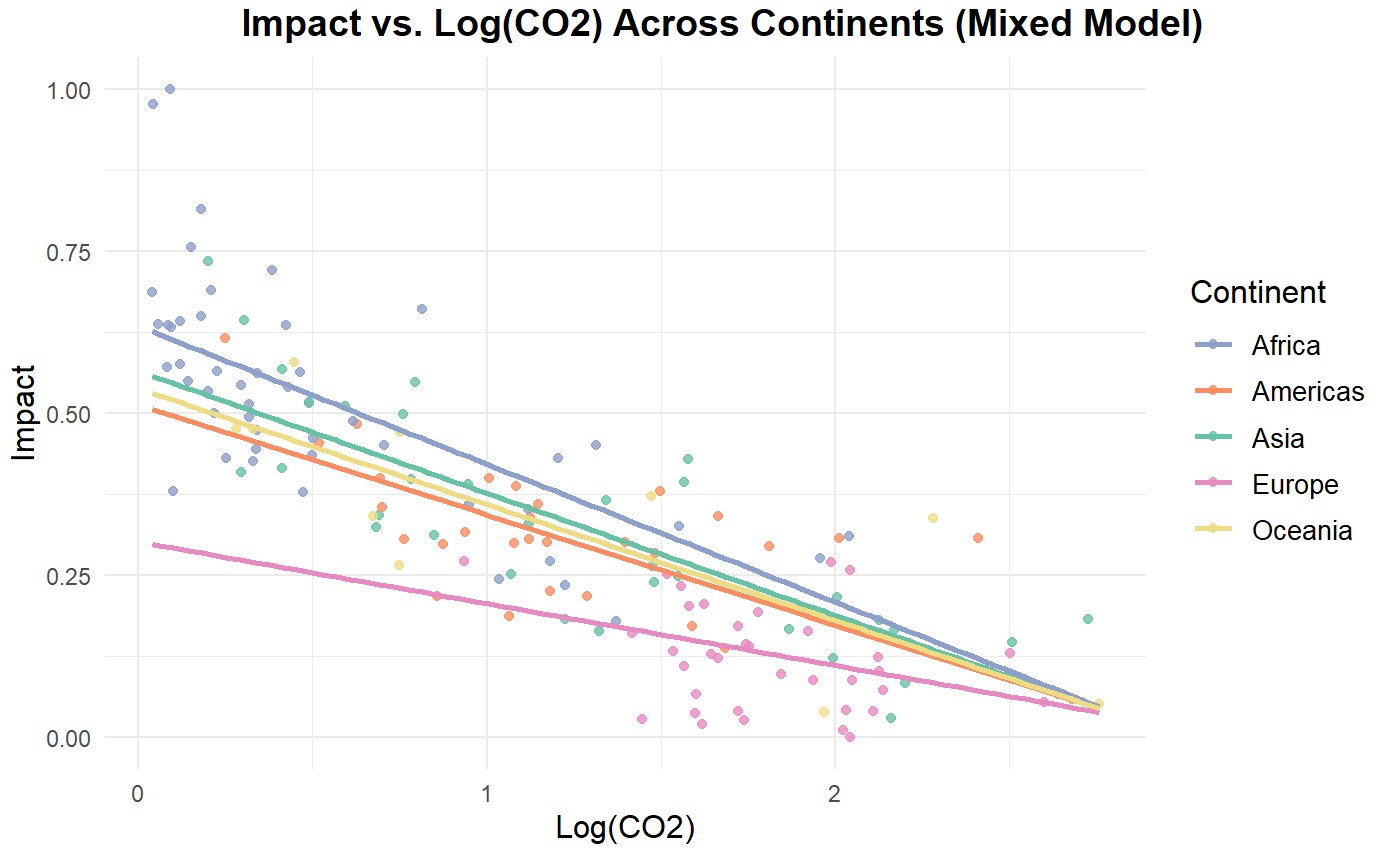
Graph 2: Mixed model correlation of impact and CO2
2. How does this correlation change over time?
This correlation shows a fairly stable temporal pattern. Vulnerability levels tend to slightly decrease across nations despite the ongoing emission of greenhouse gases and the relentless advance of climate change. This trend can be attributed to adaptation measures taken in recent decades. Some countries, such as Brazil, India, and China, have been very successful in reducing their vulnerability to climate change. In contrast, other countries, like Afghanistan, Chad, and Somalia, have comparatively failed to implement successful adaptation measures. Similarly, readiness levels have slightly increased globally, mainly due to developments in the Global North. However, readiness levels have barely increased in countries of the Global South and, in some cases, have even decreased, as seen in Venezuela and Chad. These negative changes can be attributed to economic hardship, governmental failure, and rising inequality. Consequently, it is possible that vulnerability levels will increase rather than decrease in the future for these countries.
Conclusion
This trend of countries in the Global North emitting more emissions while experiencing lower climate change impact levels is largely due to their financial and technological assets, which allows them to invest substantial resources in mitigation and adaptation strategies. As a result, their readiness against climate change is greater, reducing the overall impact. Conversely, countries in the Global South are often less affluent, leading to lower consumption and emission levels but also fewer resources to prevent the consequences of climate change. Consequently, they are more severely affected by its impacts. Additionally, the countries of the Global North benefit from generally advantageous geographic locations, making them less susceptible to heat waves, droughts, rising sea levels, and other climate-related consequences. Therefore, fewer adaptation measures are needed to achieve the same level of readiness compared to countries in the Global South. A concerning decline in readiness levels across multiple countries in the Global South has been observed over the past decades. Such developments should be closely monitored to prevent future catastrophes, such as crop failures due to droughts leading to starvation or civil unrest.
"Climate justice recognizes that the people who are least responsible for climate change suffer the most from its impacts. We must act now to rectify this injustice." - Desmond Tutu
This project highlights the unequal distribution of the burden and responsibility of climate change between the Global North and the Global South. It serves as a foundation for renewed discussions on climate justice, advocating for the principle of shared but differentiated responsibilities. This principle acknowledges that while all nations are responsible for addressing climate change, they have different capabilities and historical contributions to the problem. Wealthier nations with greater historical emissions have a greater obligation to lead mitigation efforts, provide financial and technical support to less affluent nations, and ensure a fair transition to a sustainable future. By highlighting these disparities, the project aims to inspire change by encouraging policy-makers, international organizations, and civil society to address these inequities. It calls for increased support for adaptation and resilience in the Global South, equitable distribution of resources, and inclusive decision-making processes. Ultimately, it seeks to foster global solidarity and cooperation to build a just and sustainable world for all.
What can be done to reduce this inequality between emissions and impact?
Everyone can reduce their own greenhouse gas footprint so as not to drive climate change any further. The myclimate website can be used to calculate one's own carbon footprint and provide tips on how to reduce emissions.
Furthermore, the media can also be used to track whether countries are currently experiencing severe impacts from climate change, such as natural disasters. Offering donations or other aid to help people in need can bridge this inequality.
Nevertheless, emissions and climate change are systemic issues that should be addressed on national and global levels and require substantial political efforts. Hence, to effectively combat climate change and its consequences, systemic changes are necessary. This includes a thorough incorporation of the principles of climate justice to guarantee a more just and sustainable future.