The Circle Future Earth
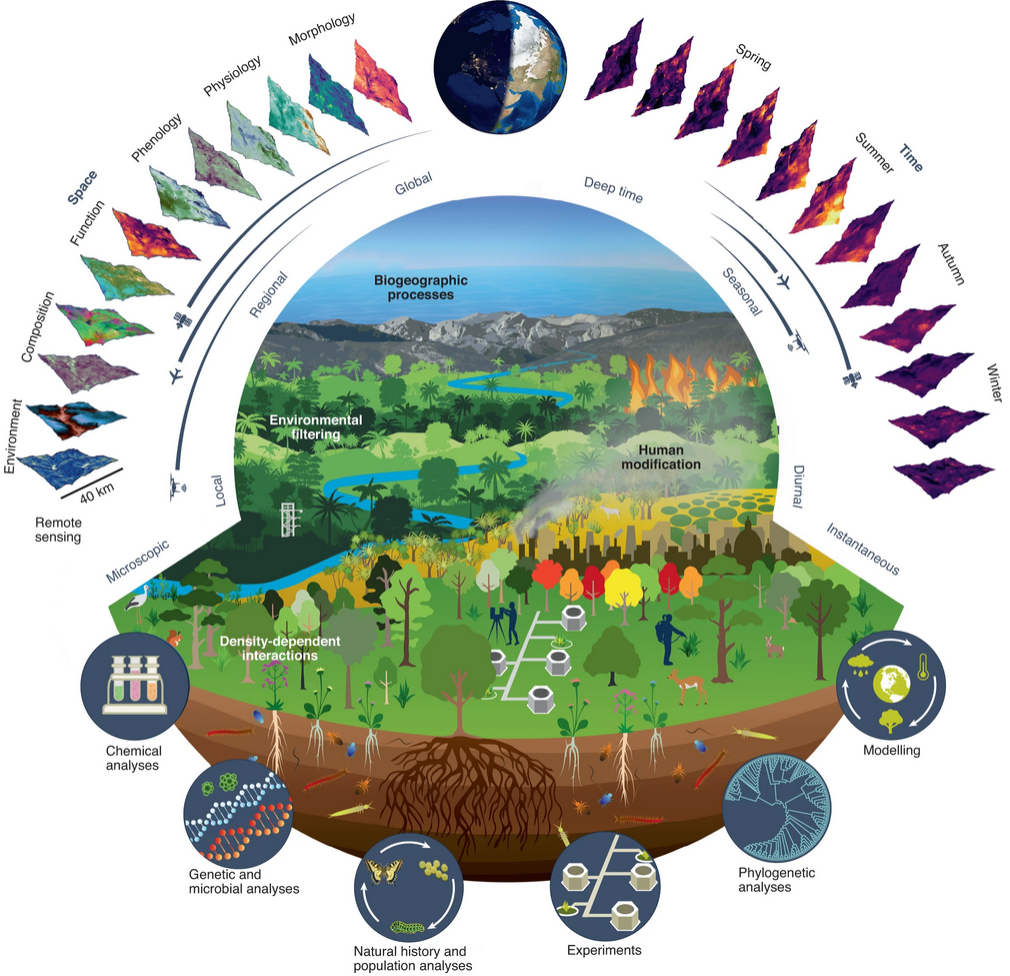
The strategic goal,'A living Earth Observation (EO) ecosystem for a living planet,' necessitates investigating new EO domains based on scientific users' needs. This comprehensive approach must cover the entire EO ecosystem, integrating satellite fleets, in-situ data, applications, and digital infrastructure. The focus is on identifying innovative methods, addressing gaps, and proposing solutions grounded in scientific requirements. The development of a science-driven EO reference architecture, prioritized across different EO systems, and analyzed over varying timelines (today, 2030, 2050), will support a dynamic, evolving EO ecosystem to meet future demands (EO blueprint looking at the time horizon 2050).Within the project, we perform a literature review to assess the current use and future scientific needs of EO to answer the following questions: Where/how do transitions in ecosystems occur? What is the land biosphere response to human activities?
Participants
Findings & Relevance
Identifying and understanding ecosystem transitions is key to local and global sustainability, and EO has a unique role in monitoring and modelling these transitions. Current usage of EO to study critical transitions focuses on landscape to regional scale transitions, using low to medium spatial resolution imagery. Given the new Sentinel-2C and 2D missions, Landsat Next, and the VIIRS sensors replacing MODIS capabilities, comparable data should be available for several decades (Ustin & Middleton, 2024). This consistency of data, providing long-term harmonised datasets, combined with expanding future EO capacity and usability, are key to the more comprehensive analyses of ecosystem transitions. Currently, measurement requirements are met for ecosystem extent and most types of ecosystem transition (Geller et al., 2023; Skidmore et al., 2020). For individual transitions, and their drivers, very high spatial resolution imagery, high spectral resolution and dense time series for temporal resolution can give more precise and timely classifications. In situ data at scales relevant to the transitions are key to understanding the underlying processes and validating EO and models. Perhaps the most important requirement given the long-term nature of many transitions is the length and continuity of data. Sustained observation enables detection of slow or subtle changes, enables us to form accurate baselines from which to detect change, and allows the retrospective analysis of transitions and their antecedent conditions.The land biosphere response to human activity is a critical area for global sustainability, and one in which EO has a unique role to play. However, the complexity of quantifying the land biosphere, and monitoring and attributing its responses, means that multiple indicators are required, across different types of remote sensing. Current EO capacity is sufficient to assess many of the facets of the land biosphere and its response to human activity (Geller et al., 2022; Skidmore et al., 2020). Some identified gaps include the need for global wall-to-wall LiDAR, higher spectral resolution at high to medium resolutions (Geller et al., 2022), and freely available very high resolution imagery (Ustin & Middleton, 2024). However, EO-relevant in situ data is perhaps more important for the calibration and validation of the vast amount of imagery available (Cavender-Bares et al., 2022). Similarly, improving the accessibility and usability of data through analysis ready products, harmonisation and data fusion can reduce the complexity of analysis and streamline the scientific process. Finally, maintaining continuity of consistent products is a critical requirement for assessing the long-term impacts of humans and climate change on the biosphere.
Funding Organization